Rejected
NeurIPS Creative AI Track 2025 · Artwork
The Most Accurate Fortune Teller
Don't Try This At Home!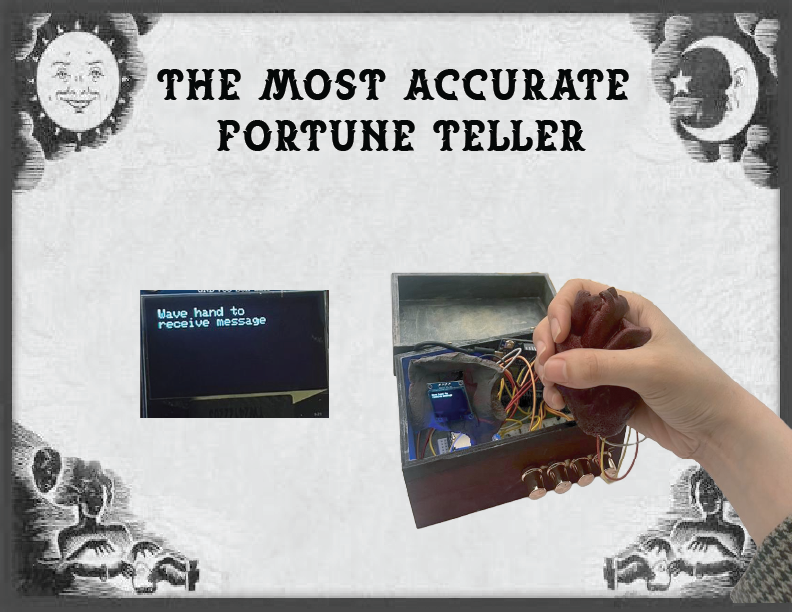
NeurIPS Creative AI Track 2025 · Artwork
The work
A physical toy, built for a utopia/dystopia brief in the MFA Design and Technology program at Parsons in spring 2025. It was submitted to the NeurIPS Creative AI Track afterward — the conference is where it was judged, not where it came from.
Abstract
"The Most Accurate Fortune Teller" is not just a toy, but a philosophical provocation. Using biometric input (heart rate), emotional feedback (vibration in a heart-beat pattern), and artificial intelligence, it simulates the generation of a meaningful message, at the same time it intentionally manipulates perception to expose the epistemic shallowness behind it. Its purpose is demonstrating how easily people can attribute meaning and depth to vague data-driven outputs when framed with emotional cues, deceptive seduction, and technological complexity that looks mystical. This is a critique, not a tutorial.
Where it starts · c. 1596
A young man holds out his palm. A woman reads it. The scene is warm, intimate, and completely convincing — which is the trick. The ritual is not the service. The ritual is the cover.
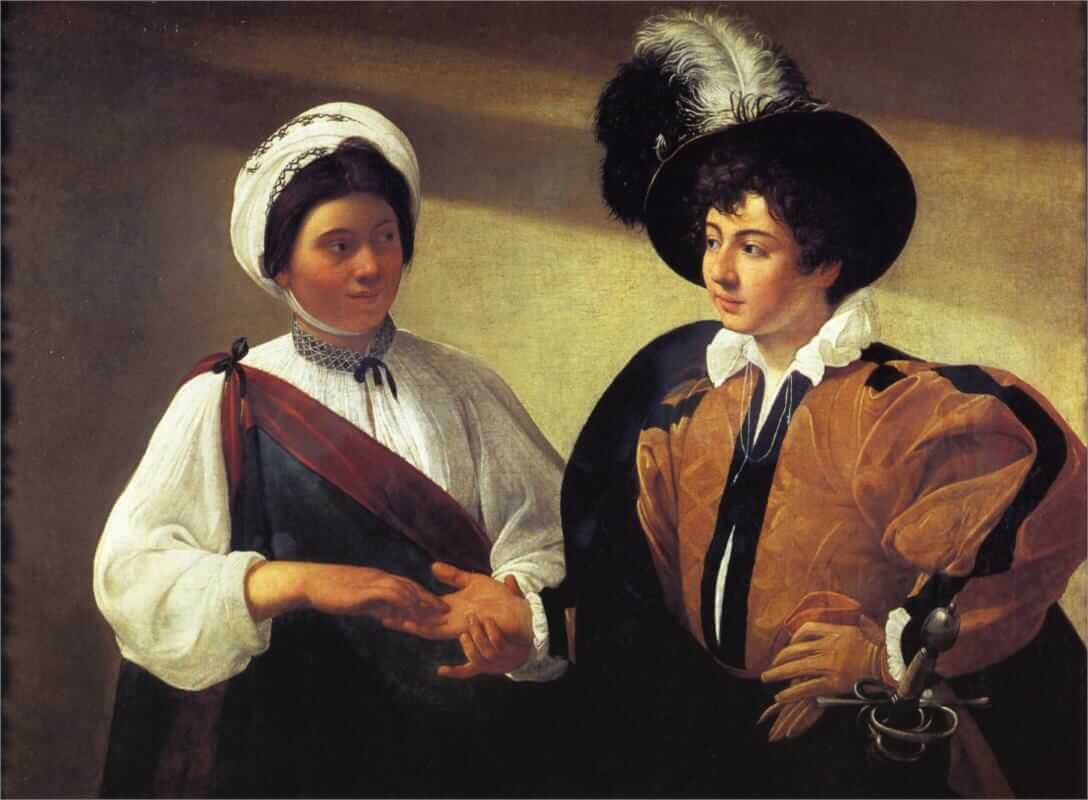
At first sight she is divining his future. Look at the hands: she is lifting his ring while she does it. The reading is real enough to hold his attention. That is all it ever needed to be.
Mario Bunge refused to treat any of this as harmless. He described superstition, pseudoscience and antiscience as "intellectual viruses" — able to infect a layman or a scientist alike, and to sicken an entire culture until it turns against research itself.
Bunge, Mario. "What Is Pseudoscience?" Skeptical Inquirer 9 (Fall 1984): 36–46.Scams this old don't die; they get re-shot with better equipment. Artificial intelligence is the current equipment.
1596
The ritual: a palm read aloud, close enough to feel personal.
What it costs you: the ring.
2025
The ritual: a resin heart, your pulse, a vibrating motor, a loading tone.
What it costs you: still being worked out.
A closer look
fortune = f(heart rate, AI)
The declared mechanism
In reality: ChatGPT wrote three sets of answers ahead of time, and your heart rate picks the set.
The answers are vague enough to land as "true" in almost any context. And if a fortune misses badly, the ritual absorbs the blame: you performed it wrong, so do it again. Nothing the machine says can ever be wrong — which is the defining move of pseudoscience, and, in sad cases, of AI too. That is the sleight of hand this toy exists to hand back to you: is AI, like the woman in the painting, divining your fate, or flattering your hope? What are you handing over, unnoticed, in the name of insight?
Your turn
You have just been shown the wiring. The trick still works — that was never in question. Consult it anyway, and watch how quickly you start looking for yourself in the answer.
The fortune is generated by our most accurate fortune teller agent, which seems to have the wit of Ambrose Bierce, the shrewdness of Machiavelli, the insights of Sun Tzu, the perceptiveness of Caravaggio, and the style of Francisco Goya if he had experienced daily the emotional release of vaping. (We didn't ask if it was trained by stolen content.)
The Most Accurate Fortune Teller
AI-Enhanced Pseudoscientific Toy
Tap below to consult the oracle. Your biometric data has already been recorded and deemed highly symbolic.
* No actual biometric data is collected. Any perceived meaning is your own projection. This is the point.
Peer review
Quality
The work is conceptually clear, drawing on historical and philosophical references to frame the toy as a critique of pseudoscience. However, the technical side is basic, using a simple heart rate sensor and pre-scripted AI outputs.
Clarity
The artistic intent is clear and the critique of AI mystification is easy to follow, but the process feels underdeveloped. As a critical gesture, it could be pushed further.
Originality
The use of AI to parody fortune telling and expose epistemic emptiness is conceptually interesting, though the implementation — mapping heart rate ranges to fortune types — is straightforward.
Significance
The project's strength lies in sparking reflection about trust in AI and pseudoscience. Yet the interaction design may undermine its impact: assigning "anxious" fortunes to high heart rates lacks clear rationale, and could frustrate or disengage audiences rather than provoke critical insight.
Strengths
Weaknesses
Suggestion
Exploring collective or dialogic interactions (multiple users comparing fortunes) might also strengthen the piece's performative and critical impact.
Rating
2: Ok but not good enough — weak rejection
Confidence
4: The reviewer is confident but not absolutely certain.
Author's response
This started with fortune teller games — the kind everyone's played at a party or a sleepover. It began as a final project at Parsons, where the semester's theme was utopia/dystopia, and that felt exactly right: every one of those games has the same thing at its core, an uncertainty about the future, and a fortune teller is always more fun as a group activity than alone.
The object itself is a resin heart with a vibrating sensor inside, controlled by four knobs that let you personalize its heartbeat pattern before a session starts. The goal was simple: make something interesting enough to hold that it primes the person to actually be receptive to what comes next. That part is a direct nod to the psychics I grew up around in Mexico, who often lead people through small rituals meant to ease them into a state where they're more susceptible to "enlightenment" — or at least more open to a new idea. A screen shows the instructions and the fortune, an infrared sensor picks up a wave of the hand to trigger a reading, and a speaker plays a suitably dramatic, magical tone while the message loads.
None of that technical layer was there to prove the fortunes are accurate — it was there to demonstrate the opposite. As creators, it's easy to assume that because we put real effort into technical features, the project must therefore work, or mean something. That's an uncomfortable thing to admit about your own work: technical complexity doesn't guarantee actual insight, and can just as easily be used to dress up nonsense. It's worth asking yourself that question directly, or you risk becoming a pseudo-science practitioner without noticing.
Which is also why it stops where it stops. It is meaningless to spend real engineering time on something that can be explained more elegantly without it. A pulse and three scripted sets produce the entire effect; anything more would have been me proving I hadn't understood my own argument. Calling that minimal is fair. Calling it a weakness assumes the technology was supposed to be the achievement — and if it had been, the piece would have been the very thing it is about.
The set was also deliberately made to look thrown-together, because that's how real fortune-telling sessions usually look — improvised, a little makeshift. Some read that as laziness. It was a conscious choice, and honestly the same argument as the tech, aimed at the aesthetics instead.
With full respect and considerable amusement:
Postscript
Some time later, the same conference invited its author to review submissions for the 40th NeurIPS, Creative Track. The machine notes this without comment. The machine assumes you'll draw your own conclusion.